Singularities for a Schrödinger Operator with
Inverse-Square Potential
\[-\Delta u+(c/r)^2 u=\lambda u\mbox{ in }\Omega\quad,\quad u=0\mbox{
on }\partial\Omega\quad,\quad c>0\quad,\quad 0\in\overline\Omega\]
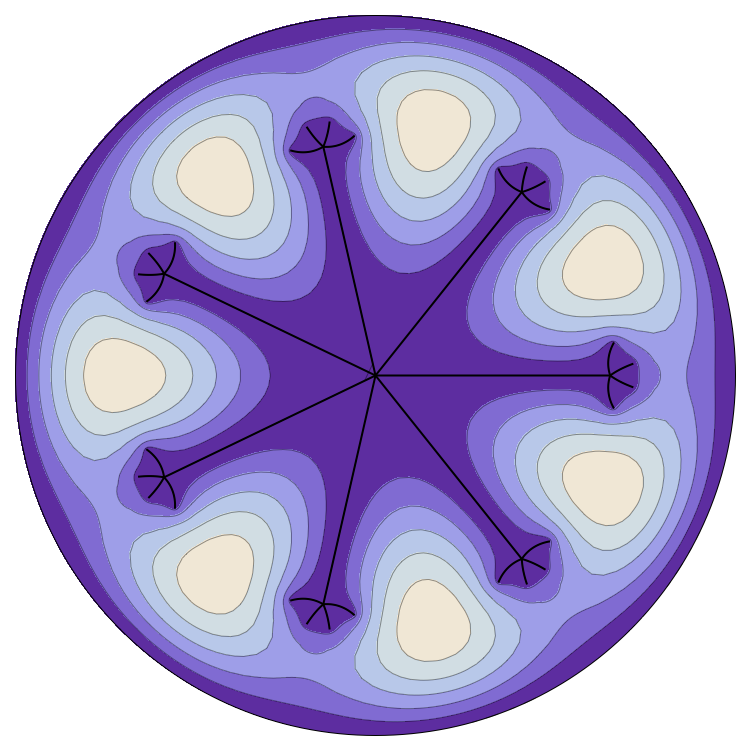
The strongest singularities for eigenfunctions occur when the origin
is in the interior of \(\Omega\), so insight is obtained by
considering the unit disk. We find the eigenvalues \(\lambda_{mn}\)
and corresponding invariant subspaces \(E(\lambda_{mn})\) for \(n\geq
0\) and \(m\geq 1\), \[ \lambda_{mn}=[j_m(\sigma_n)]^2
\quad,\quad
E(\lambda_{mn})=\mbox{span}\left\{J_{\sigma_n}(j_m(\sigma_n)\,r)\cos(n\theta)\;,\;
J_{\sigma_n}(j_m(\sigma_n)\,r)\sin(n\theta)\right\}~, \]
where \(j_m(\nu)\) is the \(m^{th}\) positive root of the first-kind
Bessel function \(J_\nu(z)\), and \(\sigma_n=\sqrt{n^2+c^2}\). When
\(n=0\) these subspaces are one-dimensional. These formulas hold for
\(c\geq 0\), but we will primarily be interested in the case \(c\in
(0,1)\). We note that the strongest singularity, \(r^c\), always
occurs in the lowest eigenmode \(\psi_1=\psi_{1,0}\).
The eigenvalue problem and associated source problem are considered
in
using first-order finite element discretizations and hierarchical-type
error estimation.
A Combination of Geometric and Inverse-Square Behaviors
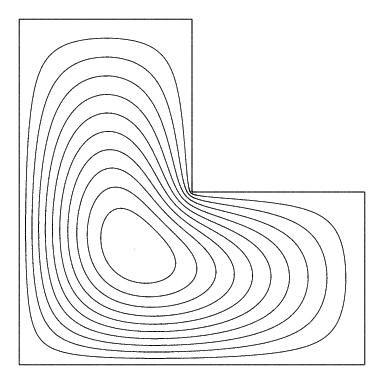
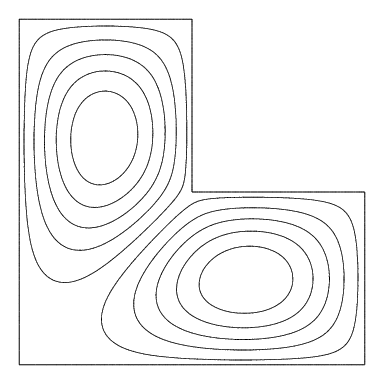
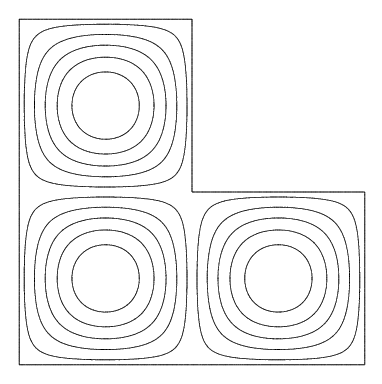
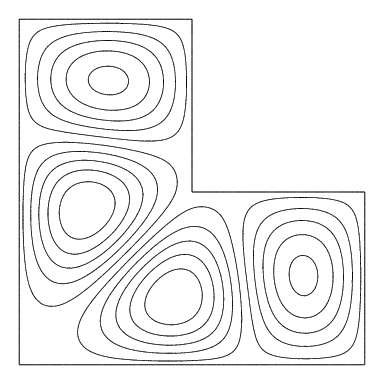
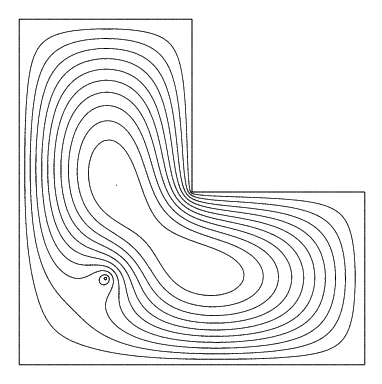
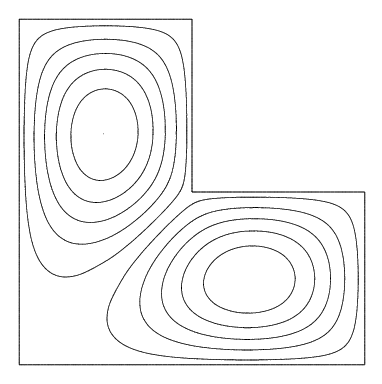
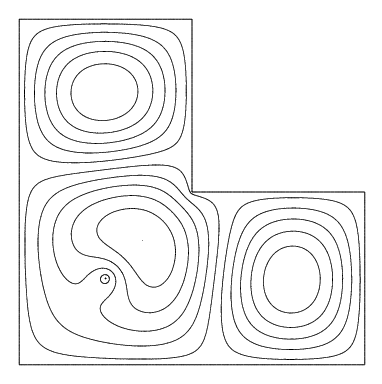
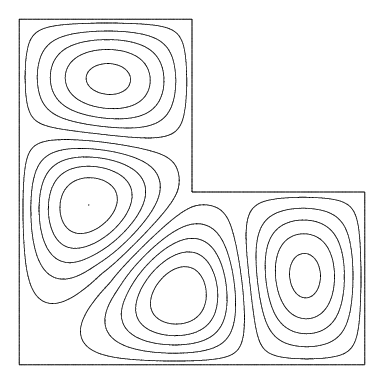
On the L-shaped domain \(\Omega=(-1,3)^2\setminus [1,3)^3\), we give contour
plots of the first four eigenmodes when \(c=0\) (top row) and \(c=1/2\) to
illustrate how eigenmode behavior can (but need not) dramatically
change when the inverse-square potential is "turned on". In the
latter case, eigenmodes could feasibly have a
\(r^{1/2}\)-type singularity at the origin and a \(r^{2/3}\)-type
singularity at the re-entrant corner.
The second and fourth eigenmodes in both cases are very similar,
though not identical, when scaled to have the same norm and signs on
the peaks and wells.